
US campaign group sets out AV safety principles
Families for Safe Streets, a US traffic safety campaign group, has published a White Paper on Autonomous Vehicles, setting out what it sees as core principles that should govern AV safety.
Above all, the campaign group warns that the safety of vulnerable road users is “non-negotiable”. Deployment, FSS says, “should proceed only when systems demonstrate consistent performance in protecting those most exposed to risk.”
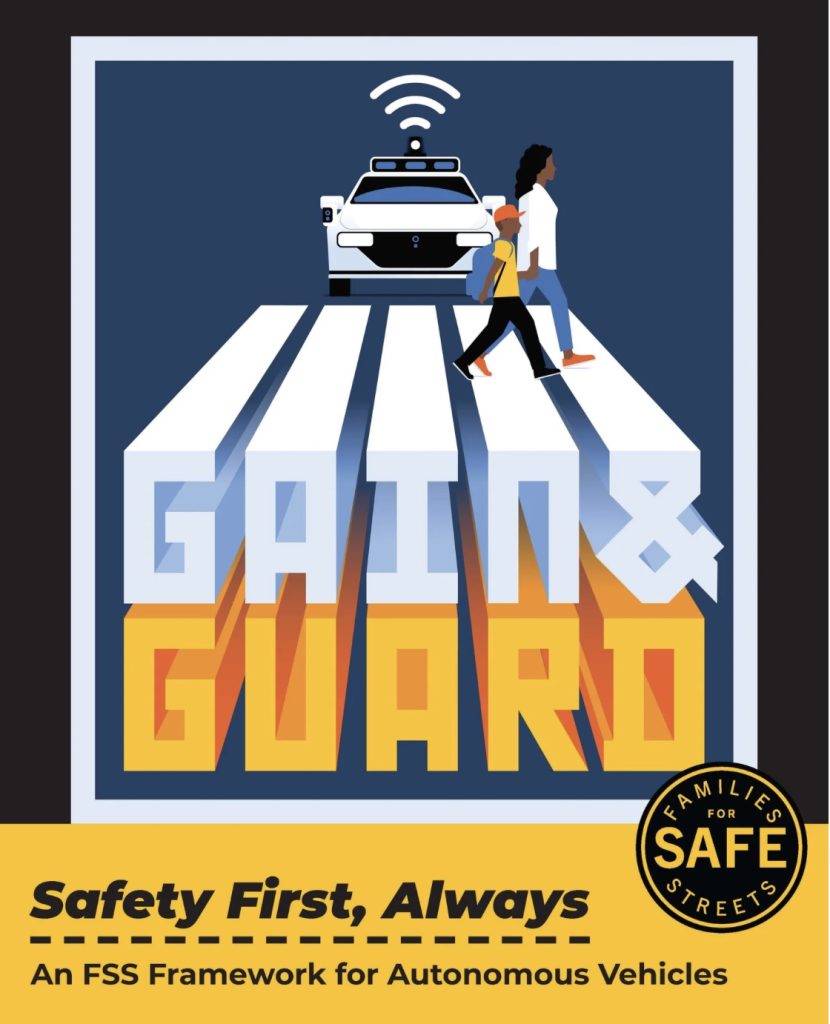
The paper focuses on robotaxi fleets and on-demand passenger services. The key demand from FSS is that AVs must be dramatically safer than human drivers on average, and never worse in any single operating environment. Before full-scale commercial deployment, FSS wants AVs to be measured against what it calls a ‘Gain & Guard Rule’. AVs, it says, must demonstrate at least a ten-fold reduction in fatality, injury, and crash rates relative to human driving, as an exposure-weighted average across all authorized operational design domains (ODDs), and not increase such rates within any individual authorized ODD.
FSS sets out how it believes its Gain & Guard Rule pairs two requirements simultaneously: “a demand for transformational overall safety improvement, and a prohibition against localized safety regressions. For the public, it provides a clear and understandable standard. For regulators and AV companies, it replaces vague ‘reasonableness’ standards with a single overarching test that organizes the full complexity of AV safety evaluation while allowing flexibility in how companies achieve it, within the rule’s safety guardrails.”
The FSS White Paper also calls for a proposed traffic law compliance framework, “The Lawful AV”, to establish regulatory intervention triggers for persistent unlawful AV behaviour. “This addresses a gap in crash and injury metrics: AVs could satisfy both prongs of the Gain & Guard Rule while still routinely passing stopped school buses or driving onto sidewalks — behaviors that pose serious risks to people even when they don’t immediately cause measurable harm”, the paper says.
The campaign group, which includes many road traffic victim families, also sets out its demand for a strong liability system tailored to the complexities of AVs. FSS wants to see AV liability following “an aviation- and maritime-inspired framework where AV companies bear automatic strict liability up to a defined compensation threshold – with assumed, but disputable, liability by the companies beyond that threshold.” The FSS paper proposes implementing this through a pooled compensation fund, collectively financed by the AV industry and providing immediate compensation to victims while ultimate cost allocation is resolved separately among the involved parties.
The FSS report concludes with a clear safety goal for the rollout of AVs: “Autonomous vehicles must meet the highest safety standards, with the ethical obligation to help us eliminate traffic deaths and injuries. They must operate transparently and accountably. And they must prioritize the lives and accessibility of everyone who uses our streets.”
The Families for Safe Streets White Paper is available here https://www.familiesforsafestreets.org/autonomous-vehicles
Images copyright Families for Safe Streets