
Global justice and Yellow Vests
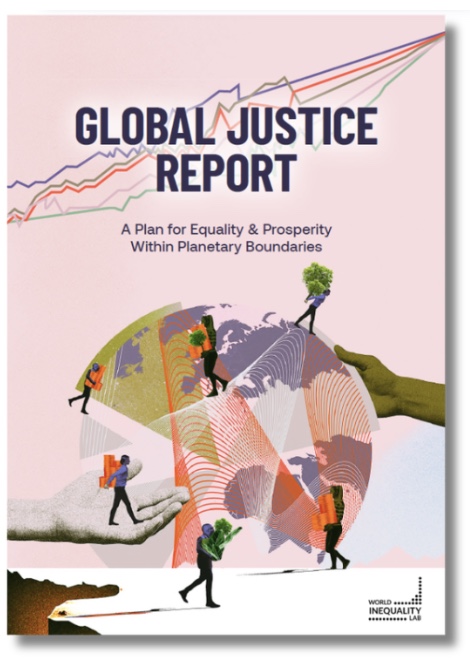
A radical prescription for global equality, decarbonisation and democracy has been published this week by economist Thomas Piketty and his colleagues in the Global Justice Project, based at the World Inequality Lab.
Launched at the 2026 World Inequality Conference in Paris, the Global Justice Report proposes a global transformation to reconcile planetary habitability and high standards of well-being for all. This seemingly contradictory goal is achievable, the report claims, if three conditions are met: Rapid decarbonisation of energy systems; a major shift away from overconsumption towards “sufficiency” (requiring a sharp reduction in labour hours and raw materials extraction, along with huge changes in consumption patterns, food habits, land use and forest cover); and a drastic reduction in inequality of income, wealth and power, both between countries and within them.
The Global Justice Project’s vision is that by the end of this century the world will:
- Achieve convergence in per capita monthly national income at €5,000 across all countries, closing today’s 16-fold global income gap.
- Increase the poorest half’s share of global wealth from 2% to 30%, while reducing the share of the ultra-rich from 6% to 0.05%.
- Enable nearly 90% of the world’s population to double their income while working roughly half of today’s labour hours.
- Limit global warming to 1.8°C through a sustainable convergence pathway combining rapid decarbonisation with a major shift toward sufficiency, including reduced labour hours and material consumption.
These objectives would be supported through a new Global Justice Fund to enable massive global investment averaging 10.3% of world GDP annually between 2030 and 2060. This redistribution compares with less than 0.4% currently allocated to development aid and international organisations. Piketty claims that the Fund could be financed through a combination of a global wealth tax, a world sovereign wealth fund, and a global income tax targeting the world’s richest individuals. It would be assisted by a parallel effort to transform and democratise the international economic and monetary system.
The Global Justice Project aligns its approach with existing inter-governmental and regional initiatives, including the Bridgetown Initiative led by Barbados and efforts addressing global inequality through the G20. But it presents the report as a contribution to a wider conversation, rather than a blueprint, recognising that there is “no silver bullet” to overcome the significant political vested interests that would resist such radical change. The authors argue for the work of building a coalition through trades unions, political parties and activist communities to proselytise the case.
For campaigners in the transportation field grappling with negative reaction to green fiscal and land use reform, and measures to balance car use with other modes, the report’s analysis of popular opposition to environmental policies, and strategies for overcoming this, is worth quoting at length:
“One difficulty that deserves special attention”, the report says, “is the following. For too long, environmental policies did not pay much attention to social inequalities. In many cases, the rhetoric of ‘classless ecology’ and ‘green growth’ – i.e. the idea that it is possible to address environmental challenges by indefinitely increasing the size of the pie and without addressing explicitly the issues of sufficiency and inequality between social classes, neither in terms of unequal responsibilities nor unequal damages – has been routinely used to promote anti-redistributive and inequality-enhancing policies.
“One caricatural example is the large carbon tax hike that was scheduled in France in 2018. This was a strongly regressive tax (including a high tax burden for average workers using their car to go to work on a daily basis, but full exemption for the kerosene used by those taking airplanes for a week-end), and the revenues were used to finance the wealth tax repeal which was being implemented the very same year (to the benefit of the top 1% taxpayers). This led to massive popular protests – the so-called ‘yellow vests’ movement – so that ultimately the carbon tax hike was abandoned (but the wealth tax repeal was maintained). In practice, ‘classless ecology’ often looks a lot like a mixture of pro-rich ecology and business-friendly greenwashing, i.e. an attempt by free-market liberals to pretend that they are doing something about global warming and planetary habitability while maintaining basically the same neoliberal, productivist policies.
A similar but distinct dynamic played out in Ecuador in 2019, when the government announced the removal of longstanding fuel subsidies as part of an IMF-backed austerity package. The subsidies were environmentally problematic, but their removal fell hardest on poor and working-class populations, and particularly on indigenous communities, who depended on affordable fuel for transport and livelihoods. The result was weeks of mass protests led by Indigenous organizations, which forced the government to reverse course. This case shows how countries with limited fiscal space are pressured by international financial institutions into reforms whose burden falls on the poorest. Without the reforms of the international order described above, and without an ambitious platform to reduce socioeconomic inequalities, even well-intentioned environmental policies risk being imposed on those least able to bear their costs and least responsible for the problem in the first place.”
https://globaljusticeproject.wid.world/global-justice-report/
Images copyright Global Justice Project