

Global business community urges better UN links
A paper published by a task team of the United Nations Global Compact has called for greater mutual understanding and collaboration between UN agencies and business to unlock scaled financial support for development goals.
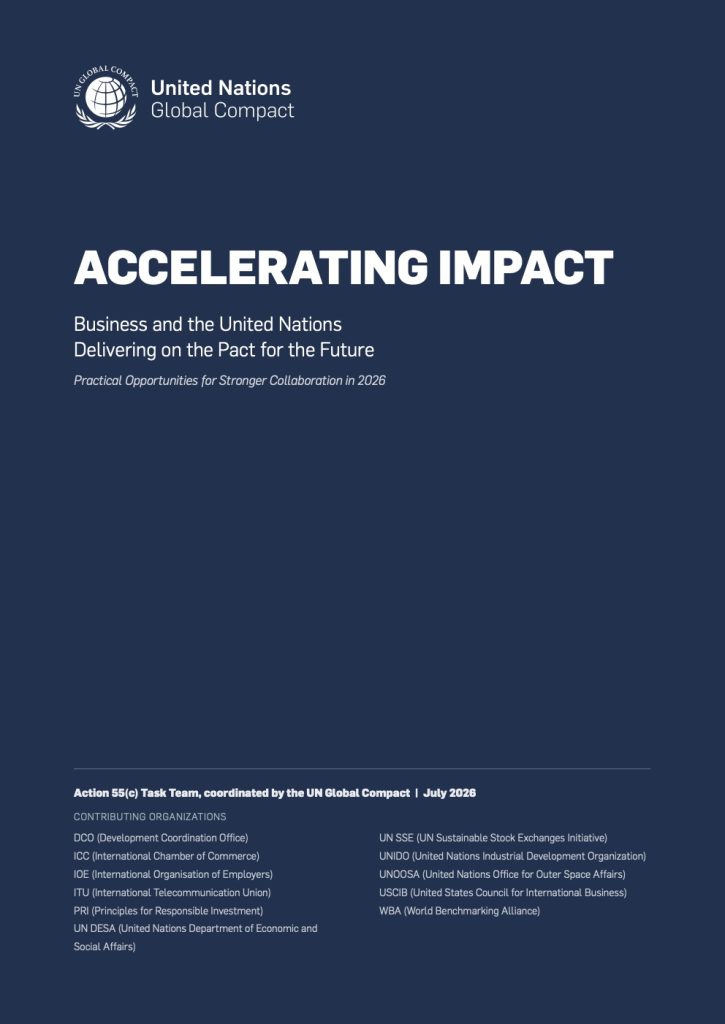
Accelerating Impact: Business and the United Nations Delivering on the Pact for the Future reports Global Compact members’ views on improving private sector support for delivering the Sustainable Development Goals and other UN priorities. Among the recommendations, the paper urges a unified business liaison channel to ease private sector participation, a better understanding by UN leaders of business cycles, and stronger government commitment to new financing mechanisms.
“Businesses frequently encounter multiple entry points across the UN system, each with different mandates, due diligence requirements, and partnership rules”, the task team says. “This increases transaction costs, slows decision-making, and discourages engagement beyond ad hoc or pilot-scale projects. There is growing appetite among companies for a dedicated resource or fast lane to help navigate across UN entities, offices, and initiatives.”
While cash-starved UN bodies, most of which have suffered massive budget cuts in the past 18 months, might be willing to lower bureaucratic barriers, there are practical issues. Some UN agencies have stricter rules on engagement with alcohol or fossil fuel companies, for example, and the question is whether unified partnership rules would weaken ethical standards for the strictest (like WHO) or completely close the door to the ‘sin’ industries.
While recognising the moral authority and convening power of the UN, the report challenges some of the institution’s working practices and assumptions. “UN planning and approval cycles frequently do not match the investment horizons of business”, the task team advises.
“This gap is most pronounced in fast-evolving sectors such as digital infrastructure, artificial intelligence, energy transition, and advanced manufacturing, where speed and capital deployment are essential…The challenge of reconciling UN processes with business timelines is therefore becoming more acute. There also remains in some contexts a residual tendency to position the private sector as a donor rather than as a strategic partner for investment and co-creation, which can limit the ambition of what partnerships achieve.”
The task team argues that there is great potential for the business community, and particularly the financial sector, to provide the investment and expertise necessary to advance development objectives at scale. “Translating development priorities into investable opportunities, through structured financing pipelines, sector-specific investment frameworks, and blended finance platforms aligned with national development plans, is the practical mechanism for mobilizing business at scale. The UN is well positioned to play this aggregating and de-risking role, but doing so requires intentional design and sustained commitment from Member States.”
Sanda Ojiambo, CEO and Executive Director of the UN Global Compact, said: “This dialogue represents an important opportunity for Member States and the private sector to work together to strengthen partnerships that can accelerate implementation of the Pact for the Future and the Sustainable Development Goals.”