

Costly journey of motorcycle helmets revealed
It is the perennial hard question facing efforts in low- and middle-income countries to increase motorcycle helmet use and improve the quality of available helmets: how to enable supply of affordable helmets that meet internationally recognised standards?
Now research from the Global Alliance of NGOs for Road Safety reveals where the price of a standard motorcycle helmet increases along the supply chain in Kenya and Mexico, showing how importation, intermediaries, distribution, and retail shape what riders ultimately pay.
Released today, the NGO Alliance’s report “The price journey of a motorcycle helmet: What really drives the cost of a standard helmet in Kenya and Mexico?” traces the costs of selected helmets meeting ECE 22 or US DOT protection requirements from manufacture to the final retail price. The study finds that the estimated manufacturer price represents around a quarter of the final price in both countries, with most of the price added at later stages of the journey.
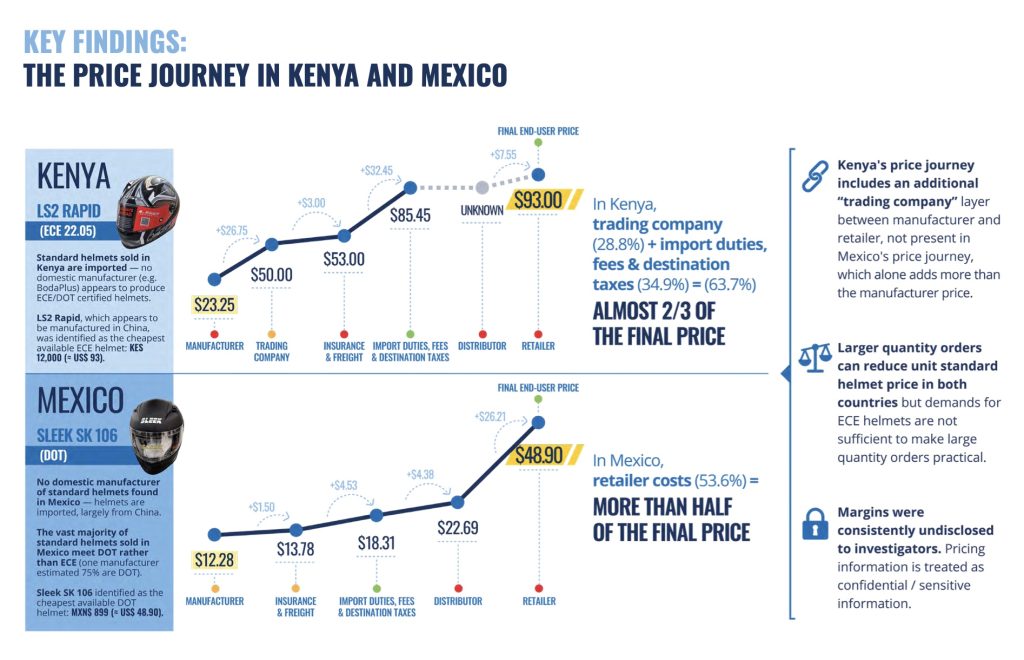
In Kenya, the LS2 Rapid helmet is sold for KES 12,000 (US$93). The trading company and import duties, fees, and destination taxes together account for almost two-thirds of the final price. Import duties, fees, and destination taxes alone represent almost 35%.
In Mexico, the SLEEK SK106 retails for MXN 899 (US$48.90). The estimated retailer component makes up more than half of the final price.
The high cost of good quality helmets has a human cost as riders purchase cheaper counterfeit or substandard helmets or do without. “Riders are expected to wear helmets, but wearing one is only part of the equation. Governments and other system actors must make sure that the helmets people can buy will protect them, and that safe helmets are within reach,” said Lotte Brondum, Executive Director of the Global Alliance of NGOs for Road Safety. “Safe helmets should not be a luxury. Understanding what riders are paying for gives us evidence to start asking where costs can come down and what different actors can do about it”
To increase availability of affordable safe helmets the NGO Alliance is calling for measures to increase demand for standard helmets to help create viable markets for local and regional manufacturing; pooled purchasing to increase buying power and potentially reduce unit prices; and greater transparency around helmet pricing so that governments, industry, and civil society can identify where costs could be reduced.
The research was conducted by the NGO Alliance with funding from Uber. It drew on retail visits, street observations, consultations with riders, retailers and manufacturers, and government and trade data. Where exact commercial pricing information was unavailable, the researchers used estimates based on the best available evidence and assigned confidence ratings to reflect the strength of the information.
Read the report here . Report image copyright Global Alliance of NGOs for Road Safety
Main photo by Edouard TAMBA on Unsplash