
Better targeting needed for air quality finance
International financing for air quality improvement is failing to target some of the countries with the worst pollution, according to a new report from the Clean Air Fund.
The report, The State of Global Air Quality Funding 2026, published this week, finds that air quality funding remains poorly aligned with need. In 2024, half of the world’s ten most polluted countries - Pakistan, Nepal, Myanmar, Cameroon and Democratic Republic of Congo – received less than $2 per person to tackle air pollution in 2024.
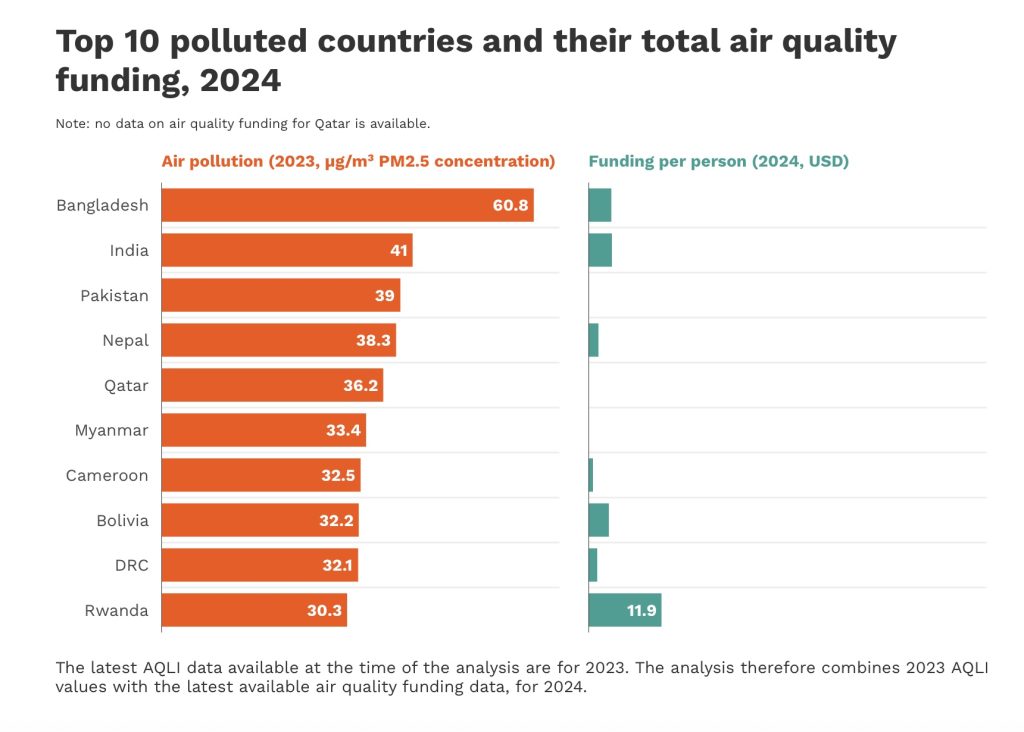
According to the Clean Air Fund this mismatch may reflect differences in countries’ ability to access development finance, as well as a lower priority given to air quality in funding decisions. Countries with weaker financial systems or limited capacity to prepare investable projects may face greater barriers to accessing finance, even when pollution exposure is high.
Loans accounted for 89% of total air quality funding between 2020 and 2024, with development banks a main source of finance. For indebted countries with significant existing loans for other needs this may also act as a barrier.
The report finds that air quality improvement remains seriously underfunded despite being one of the world’s greatest public health challenges. Polluted air causes almost eight million premature deaths annually, with economic losses equivalent to 6% of global GDP. Yet in 2024, less than 1% of international development funding went to outdoor air quality projects.
The report also finds:
- Outdoor air quality funding increased by $1.7 billion between 2023 and 2024, almost returning to its 2022 peak. Yet despite this rebound, it still represents less than 1% of international development funding.
- Air quality funding that was not related to climate also saw an increase, suggesting that some funders are beginning to prioritise air quality as an issue in its own right.
- The Philippines, India, and Bangladesh collectively received almost 56% of outdoor air quality funding in 2020-2024.
- Sub-Saharan Africa was the only region to sustain year-on-year growth in total air quality funding between 2020 and 2024.
Sean Maguire, Executive Director, Strategic Partnerships at the Clean Air Fund commented: “Air quality funding is not going where pollution exposure and health risks are greatest. Funding remains worryingly low, concentrated on a limited number of places, and misaligned with countries facing the greatest burden. With development budgets under growing pressure, clean air objectives must be built into wider development investment, so every dollar works harder and delivers benefits for health, climate and economies at the same time.”
Image: Clean Air Fund (2026). The State of Global Air Quality Funding 2026. London: Clean Air Fund. Creative Commons copyright
Photo by shun idota on Unsplash