
Air pollution affects exam day performance for poorer students, study finds
Lower-income school students could be underperforming in examinations on days with poor air quality, a study by researchers at Montpellier University suggests.
The report focuses on the effect of fine particulate matter (PM2.5), the pollutant responsible for the largest share of health and economic damages attributable to air pollution. Using administrative records for nearly five million French secondary-school students (2010–2017), combined with high-resolution PM2.5 pollution data and wind-direction-based quasi-experimental variation, the researchers, Simon Briole and Camille Salesse, found causal evidence that short-term air pollution shocks can amplify educational inequalities.
The report, published by the World Inequality Lab, finds that exam-day PM2.5 pollution reduces test scores for disadvantaged students but not for advantaged students. Exposure above the WHO threshold lowers scores by roughly 4–5% of a standard deviation in middle-school exams and 6–7% of a standard deviation in high-school exams. These effects are large relative to existing achievement gaps. Pollution-induced score losses correspond to about 9% of the socio-economic achievement gap in middle school and up to 25% in high school.
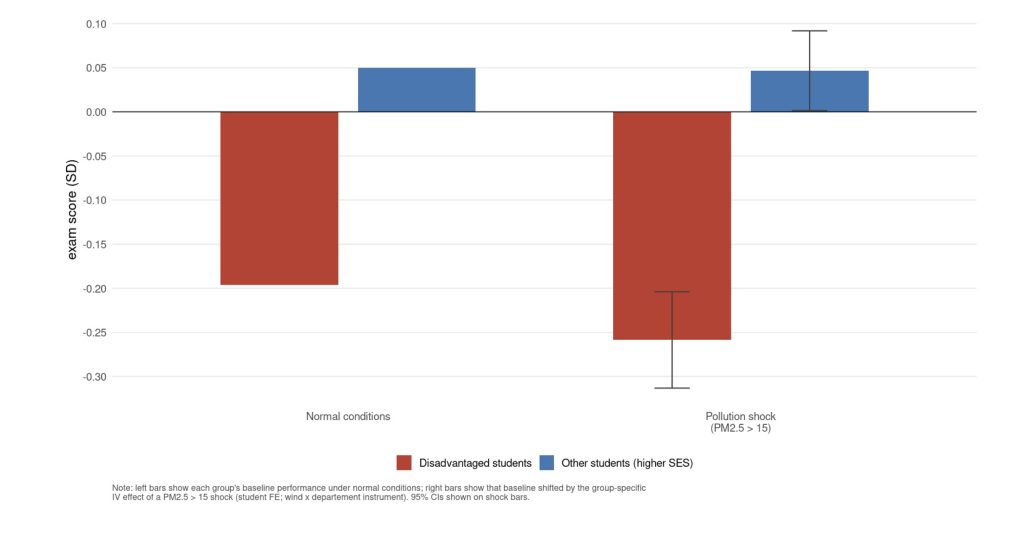
Short-term pollution shocks widen educational inequality. Rather than affecting all students equally, pollution disproportionately harms those who are already socio-economically disadvantaged.
The authors identify cognitive resilience as a key mechanism. They developed a novel individual-level measure of cognitive resilience, defined as the capacity to perform under high-stakes conditions, which showed that lower-resilience students are more vulnerable to pollution shocks. Cognitive resilience is socially stratified. Students from disadvantaged backgrounds are more likely to underperform in high-stakes exams relative to their continuous assessment grades, indicating lower average resilience.
The research finds that high-quality schools can mitigate pollution vulnerability. Low-resilience students attending high value-added schools are no longer significantly affected by pollution shocks, suggesting that educational environments can build resilience and reduce the unequal consequences of environmental exposures. While recommending targeted interventions focused specifically on exam-day conditions, for example by improving indoor air quality in examination rooms through the use of air purifiers and air-quality monitoring systems, the authors point out that both air pollution and inequality of access to quality education (a cause of the current youth demonstrations and unrest in French cities) must be addressed at the macro policy level.
Report image: copyright World Inequality Lab
Photo by Billy Albert on Unsplash